Twitch
 Followers
 YouTube
 Likes
 Subscribers
 Kick
 Followers
Why Is Twitch Growing So Much? 7 Reasons Behind Its Success
Live streaming should not work in a world of short videos, yet Twitch keeps growing. Here are the 7 reasons why, backed by data, and what it means for streamers.
 Drew Caldwell
On this page
- Twitch’s Growth in Numbers
- Is Twitch Still Growing in 2026?
- Reason 1: Real Human Connection
- Reason 2: Twitch Has Grown Far Beyond Gaming
- Reason 3: Gen Z and Millennial Viewers
- Reason 4: Algorithm Fatigue
- Reason 5: Streaming Is Now a Viable Career
- Reason 6: Amazon Has Changed the Game
- Reason 7: Competition Has Actually Helped
- What Does This Mean for Streamers?
- Where Does Twitch Go From Here?
- The Bottom Line
- Twitch Growth: FAQs
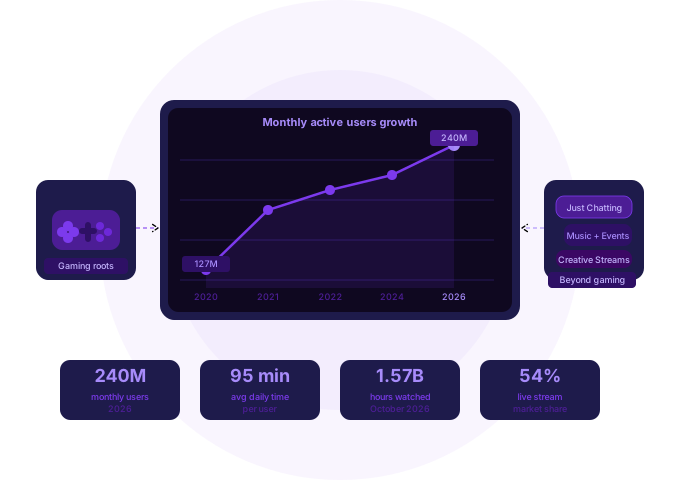
Twitch has transformed from a specialized video gaming website into one of the most engaged communities on the web. With around 240 million active users each month, about 95 minutes of viewing time per day and fast growth in music, live events and lifestyle content, the story is far more interesting than many realize. In this article, you will see how Twitch is growing and exactly why, based on facts and data.
Twitch is not supposed to be doing this well in 2026.
The idea here is that live broadcasting is far too taxing – you need to watch it in real time; you cannot fast-forward; there are no edits and none of the carefully crafted clips that algorithms push. It would seem that in today’s world filled with short-form media, a site dedicated to live unedited broadcasts for hours on end should fail miserably.
And yet Twitch has around 240 million users a month, and they spend about 95 minutes a day on it on average. But that’s not all – Twitch keeps reaching new audiences far outside the realm of video games. So why is Twitch growing when, on paper, it shouldn’t be? Here is the full story.
Twitch’s Growth in Numbers
Before we look into the reasoning behind the growth, it’s helpful to know just how big it has been.
The number of adults in the US who consume any content on Twitch has grown by seven percentage points in the past four years, while the number who view content on a weekly basis has risen by five percentage points, according to CivicScience.
The platform’s current stats paint a clear picture:
| Metric | Figure |
|---|---|
| Monthly active users | About 240 million |
| Daily visitors | About 35 million |
| Average daily viewing time | About 95 minutes |
| Share of the live streaming market | About 54% |
| Monthly active streamers | About 7 million |
Rounded figures from public Twitch statistics. They change from month to month.
Twitch’s share of around 54 percent of the live streaming market is worth thinking about. The rise of YouTube in the last few years cannot be denied, since it now holds around 24 percent of the market. Kick has also made an entry, with around 11 percent. But Twitch still holds more than half of the live streaming market.
Who watches Twitch in 2026
About 1 in 5 Twitch viewers now watch non-gaming content regularly.
Is Twitch Still Growing in 2026?
Twitch’s growth has not been a straight line. Hours watched more than doubled during the 2020 pandemic and peaked in 2021. After that, viewership slowly cooled, and in 2025 it dropped about 10% as YouTube Live grew and Twitch’s view bot crackdown removed fake viewers from the counts.
Twitch hours watched per monthJanuary 2019 to October 2026
But 2026 shows a turnaround. In October 2026, Twitch recorded 1.57 billion hours watched, its most-watched month of the year, and 2.17 million average viewers, a 16-month high, according to Streams Charts. So yes, Twitch is growing again, this time from a more honest baseline without the bots.
Reason 1: Real Human Connection
The first and most fundamental factor behind Twitch’s success cannot be quantified but is easy to feel.
There is a distinctive feature of Twitch that sets it apart from other competitors, such as YouTube, Netflix, or TikTok. When users watch something on Twitch, they are not just consuming entertainment but becoming part of a living community. The streamer can mention them by name when answering their question, and others react to the very same moments in real time. Viewers start inside jokes, create running gags and get acknowledged by the streamer personally.
This is why people are drawn to Twitch. This kind of connection cannot be generated by an algorithm or by traditional show business. On Twitch, it happens naturally.
While many companies made their products more automated and profit-driven, Twitch remained faithful to itself and managed to retain a sense of humanity that characterized its community. This has become an increasingly important advantage with today’s social media users.
According to data collected by CivicScience, Twitch users are much more inclined to trust social media influencers and buy the products they recommend.
Reason 2: Twitch Has Grown Far Beyond Gaming
The first and foremost thing people think about when mentioning Twitch is that it is a gaming platform. That idea has been out of date for at least five years.
From a platform which used to host only video games and esports to now hosting a variety of content to consume, there has been a change in the dynamics of the platform. Even though the category that sees the maximum consumption from Twitch viewers is casual video gaming, nearly one out of every five Twitch viewers consumes non-gaming related categories like music, live events and creative content.
As of 2026, the most watched category on Twitch is Just Chatting. This category is streamers talking to their audience, discussing current affairs, reacting to various things and living their life in general – something more akin to a radio show than gaming.
After Just Chatting come categories such as music, IRL (in real life), live events, art and sports. Twitch has become an entertainment destination that just happens to host the largest gaming community, rather than a gaming site alone.
Every additional content category that Twitch is able to host successfully means reaching a whole new set of audiences – people that may never watch gaming but could easily spend hours consuming content related to music, cooking, and reacting to events.
Reason 3: Gen Z and Millennial Viewers
Age composition is another highly undervalued growth driver for Twitch.
First of all, it should be noted that Twitch tends to attract more youthful audiences: the largest segment comprises individuals aged 20–39, i.e., digital natives who were born with gaming culture embedded in them. According to VenueLabs, the share of daily viewers among Millennials aged 30-44 increased to 21%, while among Gen Z aged 18-29, the rate rose to 30%.
The thing about these generations is that they grew up in a completely different media environment from the generations raised on television, radio and even early social networks. The members of these generations are used to seeing videos on YouTube, learning about gaming culture via popular streamers such as Ninja and Pokimane, and watching people play games.
This means that Twitch is not a substitute for entertainment for them; rather, it is entertainment itself. As these individuals grow older and earn and spend money, their significance only grows.
It should also be mentioned that people who joined Twitch at 20, attracted by a new game launch, often stay loyal as they get older, while new young users keep joining.
Reason 4: Algorithm Fatigue
In 2026, the most interesting irony in digital media is that the more advanced recommendation algorithms become, the less we trust the recommendations and content served to us.
When we see a YouTube video, we know we’ve been recommended that particular one to get us engaged in the process and maximize our watch time. We know how Instagram feeds operate, with its AI selecting posts that would interest us. The very name of TikTok’s For You Page suggests the algorithmic curating of your feed. Thus, there appears to be an increasing trend towards algorithmic fatigue – we long to consume something selected and chosen on purpose. This is our own reading of the trend rather than hard data, but it matches how many viewers talk about Twitch.
What distinguishes Twitch from everything else is exactly this: it depends far less on recommendation engines and content curation than other platforms, thus offering a genuine viewing experience. When you tune into someone’s live stream, you aren’t watching pre-selected footage but seeing live what happens right then and there, something the streamer couldn’t have prepared for you beforehand. Moreover, live streams allow for immediate chat and interaction with other people.
All this makes Twitch a more attractive option for younger generations who’ve learned to distrust other social media due to their algorithms and AI curation of the content presented.
Reason 5: Streaming Is Now a Viable Career
Not only does the platform get users, it gets creators.
The more creators there are, the more diverse and plentiful the content on the platform becomes. In turn, this attracts other users.
Twitch has created one of the best monetization systems among all digital media platforms today. From subscriptions to Bits donations to ads, sponsorships, and merchandise sales, the streamers have various income opportunities throughout their lifecycle on the platform.
The statistics are impressive: about half of the revenue generated by the top Twitch creators comes from sponsorships and brand collaborations. According to Resourcera, top partners can earn millions of dollars a year. Nevertheless, even at the intermediate level, earning an income is possible: a streamer having several thousand regular subscribers can earn money via subscriptions combined with sponsorship deals occasionally.
It is precisely because the platform provides for the financial sustainability of its creators that many talented individuals start streaming as a viable source of income. As a result, the content they produce on Twitch grows in quality, thus attracting more viewers.
Thanks to the Affiliate program, which since June 2026 requires only 25 followers, 4 hours of streaming on 4 unique days and an average of 3 viewers within 30 days, streamers can monetize their activity at an early stage. Since May 2026, every streamer can even earn Bits and subscriptions before reaching Affiliate, although withdrawing that money still requires Affiliate status. This accessibility plays a significant role in ensuring creator retention, which is especially important during those early and tough months when many creators quit the game.
Reason 6: Amazon Has Changed the Game
Twitch has been owned by Amazon since 2014. Up until recently, the connection seemed like a relatively distant one — Amazon bought the platform and let it operate on its own accord. That is changing.
Twitch has grown further since Amazon tied it to Prime. Prime Gaming (now part of Amazon Luna) offers Prime members a range of perks, including a free monthly channel subscription on Twitch, free game content, and exclusive in-game perks. All of this ensures that Twitch has access to the massive Prime customer base, making it easier for potential users to join the community.
Finally, the company’s marketing and e-commerce technologies are increasingly being used in combination with Twitch’s community-based platform. Businesses have been getting acquainted with Twitch’s advanced ad formats, including shoppable ads that let viewers buy products while they watch a stream.
Reason 7: Competition Has Actually Helped
But as contradictory as it seems, the emergence of Kick may well have had a positive effect on Twitch.
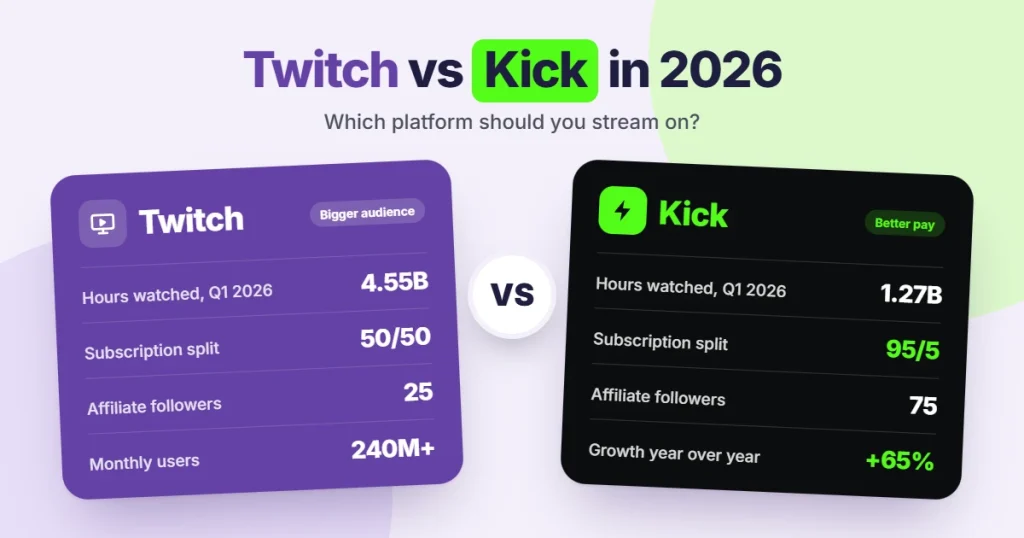
Launched in 2022 with a highly favorable revenue split for content creators (95/5, compared to Twitch’s standard 50/50), the site gained some popularity among famous streamers and proved itself as a strong alternative. The obvious response from most observers was that Twitch’s business is seriously affected.
In reality, the situation turned out to be more complicated than expected. Several star streamers have switched to Kick. Other streamers chose to switch back to Twitch or even stream on both sites simultaneously. Moreover, due to the competitive nature of the situation, Twitch was compelled to make significant improvements, such as dropping its exclusivity rules in 2023 so streamers can stream on other platforms at the same time.
The effect was profound. Creators no longer have to choose one platform, since they can stream on two sites at the same time.
Many creators now use Twitch as the base where the main audience is built, while YouTube and Kick provide an extra channel for reaching viewers. In addition, the overall growth of the live streaming market positively affects Twitch as more users get acquainted with live streaming as such.
What Does This Mean for Streamers?
As a result, if you are planning on creating a Twitch channel, this information is both promising and intimidating, as the increasing competition and growing popularity of the platform means that the road ahead may prove to be extremely difficult.
Channels that will see the fastest rate of growth on Twitch in 2026 will be those that take advantage of the unique features of the platform, such as direct connection with one’s audience, regularity, authenticity and a feeling of realness associated with Twitch streams.
Some interesting facts and implications from the growth rates data:
Diversification outside of gaming – this is great news for all creators who aren’t gamers but want to make content in another category. Be it music, food, fitness, lifestyle or anything else – there is an audience for your streams. A Twitch channel does not require you to be a gamer at heart.
A loyal, high-intent audience – Twitch viewers are willing to buy products, especially those recommended by their favorite creators.
Hard at first, rewarding in the end – Despite the many growth opportunities of the platform, starting out with a Twitch channel may prove difficult because of the ‘cold start’ problem. This means that Twitch’s directory favors channels that already have viewers, which makes it extremely difficult for a new channel to grow.
If you want to speed up your Twitch channel’s growth rate, you can buy real Twitch followers from StreamerPlus.
Where Does Twitch Go From Here?
Here is how Twitch got to where it is today:
Twitch’s growth timeline
- 2011Twitch launchesSpun off from Justin.tv as a gaming-focused site
- 2014Amazon buys TwitchBacking from one of the world’s biggest companies
- 2016Twitch PrimePrime members get a free monthly channel subscription
- 2020Pandemic boomHours watched roughly double in a few months
- 2021All-time peakClose to 2.4 billion hours watched in a single month
- 2022Kick launchesA 95/5 revenue split puts pressure on Twitch
- 2023Multistreaming allowedStreamers can go live on other platforms at the same time
- 2025View bot crackdownFake viewers removed; Prime Gaming moves to Amazon Luna
- 2026Back on the riseEasier Affiliate rules and a 16-month viewership high
Growth hasn’t ended yet, however. Several trends in the coming years will determine if Twitch maintains its forward momentum:
Shoppable live content is a key short-term driver for Twitch. When the platform’s engaged community of live viewers combines with Amazon’s e-commerce capabilities, something magical happens: if Twitch manages to make the shopping experience integral to the live stream experience, it transforms from being a great platform to being a completely different and much larger platform altogether.
International growth is the key long-term growth driver. Currently, the majority of the Twitch community comes from Western countries. While there has been some growth in Latin America and Asia, the potential pool of users in those countries outstrips the current Twitch user base. The Spanish-language segment is one of Twitch’s fastest-growing communities.
Improvements in AI technology and tooling will reduce barriers to entry, potentially bringing on board millions of creators who previously found starting their own live stream difficult due to technical barriers.
You can track real-time platform activity through tools like TwitchTracker and SullyGnome — both excellent free resources for monitoring category trends, peak times, and competitive landscape shifts.
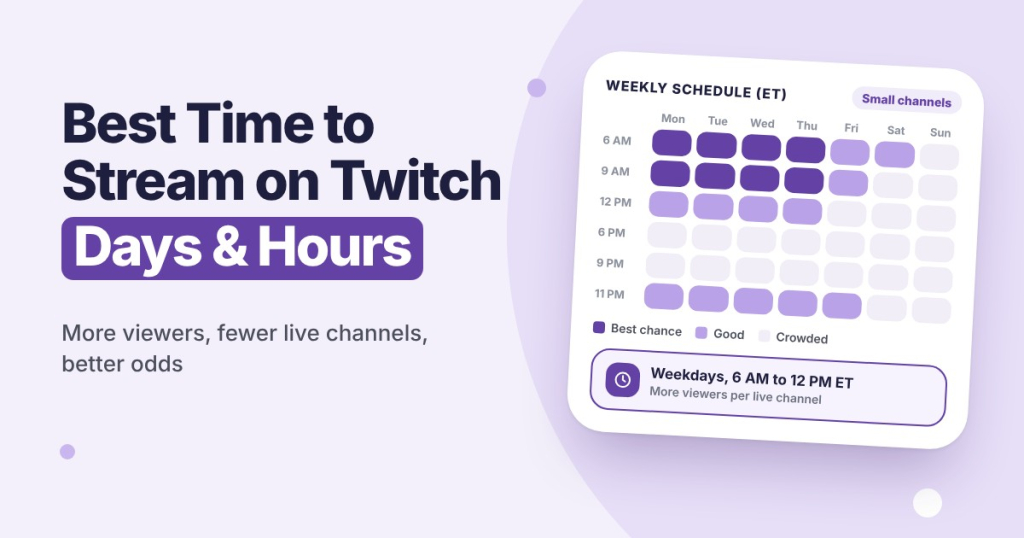
Our guide to the best time to stream on Twitch shows how to find the hours when your audience is most active.
The Bottom Line
Why is Twitch successful? Simply put, Twitch provides a truly unique experience compared to other services – a connection to something truly live and raw. This value is going to increase in a world where algorithms and synthetic experiences are becoming ever more prevalent.
From diversification, to an increasing range of creators, to increased participation by Amazon, to the dedication of their young fans who spend a lot of money on Twitch subscriptions, everything suggests one thing. Twitch is just getting started.
Twitch Growth: FAQs
Quick answers about how Twitch is growing in 2026.
01Is Twitch still growing in 2026?
Twitch is still one of the biggest live streaming platforms, with around 240 million monthly users. Its hours watched dipped in 2025, partly because the view bot crackdown removed fake viewers, but in October 2026 it hit 2.17 million average viewers, a 16-month high, and it keeps growing beyond gaming into music, IRL and live events.
02Why is Twitch so popular?
Twitch offers something most platforms can’t: real-time connection. Viewers can talk to the streamer and to each other in chat, which builds loyal communities that keep people coming back every day.
03Who owns Twitch?
Twitch has been owned by Amazon since 2014. Through Prime Gaming, now part of Amazon Luna, Prime members get a free monthly channel subscription on Twitch.
04Is Kick bigger than Twitch?
No. Kick has grown since its 2022 launch thanks to its 95/5 revenue split, but Twitch still holds more than half of the live streaming market, compared with around 11 percent for Kick.
Drew Caldwell is a consultant, researcher and editor-in-chief of the StreamerPlus blog. His work focuses on social media, marketing and digital strategy, using data analytics to help creators understand platform algorithms and grow their audience.