Twitch
 Followers
 YouTube
 Likes
 Subscribers
 Kick
 Followers
Best Time to Stream on Twitch: Days, Hours and How to Find Yours
The best days and hours to stream on Twitch as a new streamer, and how to use Twitch’s Time to Stream tool to find the right slot for your game.
 Drew Caldwell
On this page
There is no single best time for everyone. The best time is when your viewers are online and fewer streamers are competing for them.
- Biggest audience: evenings and weekends, but that is also when the most channels are live.
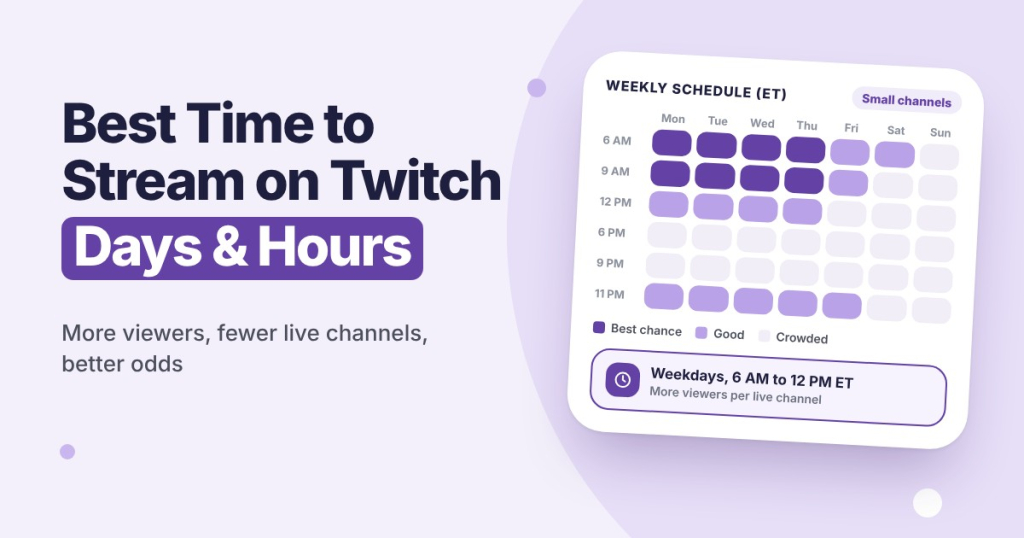
- Best chance for a small channel: weekday mornings to early afternoon US time, and late at night in your own time zone.
- Most accurate answer: Twitch’s Time to Stream tool, which shows when viewers watch your category.
If you have ever gone live to zero viewers, it is tempting to blame the time slot. Timing does matter, but the best time to stream on Twitch is not always when the most people are online. Going live at peak hours often means you start at the bottom of a very long list. This guide explains how to pick hours and days that give a new channel a real chance, and how to check the numbers for your own game.
Why the Busiest Hours Aren’t Always the Best
Twitch lists live channels in each category by viewer count, from highest to lowest. When thousands of people are live in the same game, a new stream with two viewers ends up far down the page where almost nobody scrolls.
That is why the number that matters is not how many viewers are online, but how many viewers there are for each live channel. In August 2026, TwitchTracker’s statistics put the 7-day average at about 2.2 million concurrent viewers spread across roughly 91,000 live channels, or around 24 viewers per channel. In one snapshot taken at 9 am Eastern on a Saturday that month, the number of live channels was 23% below the daily average while viewers barely dropped, which pushed that ratio up to about 31.
One snapshot is not a rule, but it shows the idea: some hours have nearly as many viewers as peak time with far fewer streamers. Those are the hours a growing channel should look for.
Best Times to Stream on Twitch by Goal
Use these windows as a starting point. Times are shown for a US audience, so shift them to the time zone of the people you want to reach.
| Your goal | When to try | Why it can work |
|---|---|---|
| Grow a small channel | Weekdays, about 6 am to 12 pm Eastern | Many US streamers are at work or school, while viewers in Europe are in their afternoon. |
| Reach late-night viewers | About 11 pm to 3 am in your time zone | Fewer channels are live, and night owls plus viewers abroad are still watching. |
| Build a local community | Right after school or work hours where you live | People who share your language and time zone can join live and come back. |
| Reach the biggest audience | Evenings, about 6 pm to 11 pm, Friday to Sunday | Most viewers are free, but so are most streamers, so standing out is harder. |
These are general patterns, not guarantees. Your category can look very different, so check it with the steps below.
Best Days to Stream on Twitch
Weekends usually bring the largest audiences, especially Friday and Saturday nights. They also bring the most competition, because that is when hobby streamers have free time too.
Weekdays, Monday to Thursday, are often a better place to start for a small channel. Fewer people go live, so you can rank higher in your category and get noticed by viewers who browse instead of watching their usual favorites.
The best day is also the one you can repeat. A Tuesday stream every week will do more for your channel than a random Saturday once a month.
How to Find Your Own Best Time
General advice only gets you so far. The real answer depends on your game, your language and your audience. Here is how to find it:
- Open Twitch’s Time to Stream toolYou find it in your Creator Dashboard. It shows the average number of viewers on channels in a category across the day, for the last 7 or 28 days, and you can leave out the biggest channels so big events don’t skew the chart (Streams Charts).
- Compare viewers with live channelsOn sites like TwitchTracker or SullyGnome, open your game and look at viewers and live channels by hour. Look for times when viewers stay high but the number of channels drops.
- Test one time slot for two to three weeksKeep the same days and hours long enough for people to learn your schedule. One stream tells you very little.
- Check your stats and adjustIn your stream summary and channel analytics, compare average viewers, chatters and new follows for each slot. Keep what works and drop what doesn’t.
Pick a Category Where You Can Be Seen
Timing and category work together. Huge categories have the most viewers, but also so many channels that a new stream is easy to miss. Smaller and mid-size games, or a niche within a bigger game, often give you a better viewers-to-channels ratio.
Before you commit to a game, check how many channels are live at your chosen time and where you would appear on the list. If you would be on the first page or two, you have a real chance of being found.
Tip: watch when the biggest streamers in your category usually end their streams. Their viewers often look for someone new to watch right after, which can be a good moment to be live.
Stay Consistent Once You Choose a Time
A good time slot only pays off if people know when to find you. Add your streams to your Twitch schedule, keep the same days and start times, and share them on your social channels.
Many streamers find that longer sessions of two to three hours give viewers more chances to discover them, but only stream as often as you can keep up. A schedule you can stick to beats a busy one that leads to burnout.
Your first few streams can feel quiet while you build a schedule. Some creators use a small package of Twitch viewers so new visitors don’t land on an empty channel, or add Twitch followers to make a stronger first impression. For more ways to grow, read our guide on how to get more viewers on Twitch, or start with how to stream on Twitch if you are just setting up.
Best Time to Stream: FAQs
Quick answers about planning your Twitch schedule.
01What is the best time to stream on Twitch for beginners?
For many new streamers, weekday mornings to early afternoon US time, roughly 6 am to 12 pm Eastern, and late nights after about 11 pm work well, because fewer channels are live. Check your own category in Twitch’s Time to Stream tool to confirm.
02What is the best day to stream on Twitch?
Weekends have the biggest audiences but also the most competition. Small channels often do better on weekdays, Monday to Thursday. The best day is one you can stream on every week.
03Is it bad to stream during peak hours?
Not always. If you already have a community, peak hours can bring more viewers. For a brand-new channel, peak hours usually mean being buried under thousands of other streams, so quieter hours are often a better start.
04Which time zone should I plan my schedule around?
Plan around the people you want to reach. If you stream in English for a US audience, use US times. If your viewers are mostly in Europe or Asia, use their local evening and weekend hours instead.
05How long should a Twitch stream be?
Many streamers aim for two to three hours or more, because longer streams give people more time to find you. Choose a length you can keep up every time you go live.
06Does Twitch show when my viewers are online?
Yes. The Time to Stream tool in your Creator Dashboard shows when viewers watch your category, and your stream summaries show how each of your own streams performed.
The Bottom Line
Streaming when Twitch is busiest is not the same as streaming when you are most likely to be seen. Start with quieter weekday hours or late nights, check your category in the Time to Stream tool, test one schedule for a few weeks, and keep the slot that brings people back.
Drew Caldwell is a consultant, researcher and editor-in-chief of the StreamerPlus blog. His work focuses on social media, marketing and digital strategy, using data analytics to help creators understand platform algorithms and grow their audience.